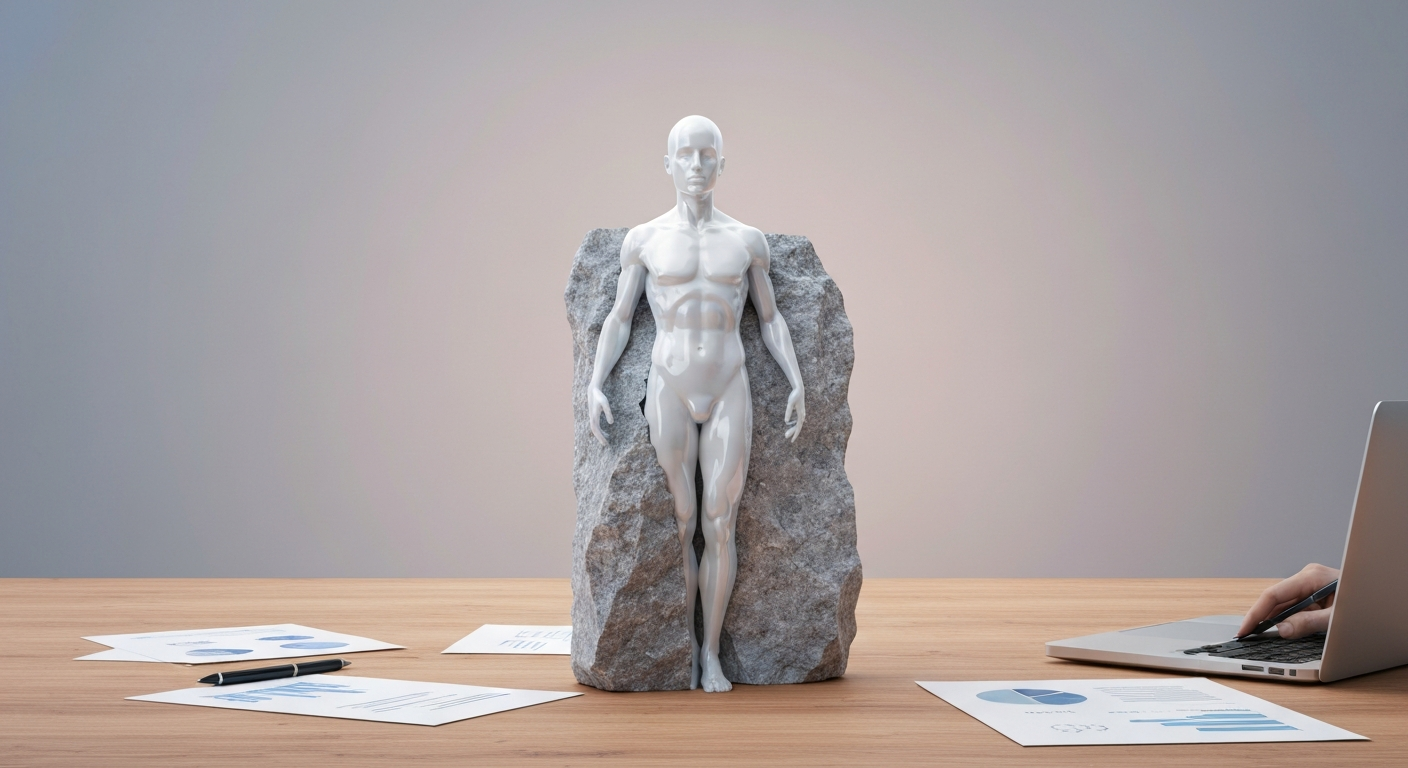
Why everyone started using AI for resumes
Generative tools have become a convenient way to quickly prepare a resume or adapt it for a specific job vacancy. Microsoft describes Copilot as an AI assistant that can help create a resume structure, suggest phrasing, and tailor text to a job description.
Specialized services also actively use AI for resumes. Kickresume states that its AI Resume Writer is trained on resumes, job openings, and recruiter feedback, and uses a fine-tuned GPT-4.1 to write content for specific roles. Rezi offers AI Keyword Targeting, which compares your resume to a job description and shows which keywords are missing.
In other words, the very idea of using AI for a resume no longer seems strange. The problem isn't that a candidate uses the tool; the problem starts when they put their resume entirely on autopilot.
What is 'plastic' text in a resume?
"Plastic" text is text that sounds professional at first glance but provides no real insight into the candidate. It is full of generic phrases: "responsible," "results-oriented," "team player," "strong communication skills," "fast learner." Such words alone do not demonstrate experience.
AI detectors for resumes, such as UseResume, explicitly point to typical signs of template-based AI text: repetitive constructions, identical bullet point structures, rounded metrics, predictable phrases, and overly general achievements without project names or context.
Pangram, which offers an AI detector for recruiters, highlights the difference between light AI-assisted editing and entirely generated applications. The service positions its detection as a way to distinguish candidates who simply checked their grammar from those who "outsourced" the entire text to artificial intelligence.
Why resumes after AI often sound identical
AI doesn't know your experience unless you provide it. If you submit a prompt like "create a resume for a marketer" or "improve my resume," the tool will fill in the gaps with generic phrases. It doesn't know how many people were on your team, what budget you managed, what metrics changed after your work, what tools you used, or what exactly was challenging about the project.
Harvard Resource Solutions suggests using ChatGPT as a tool, not a "crutch": AI can help you get started, but the result needs to be edited and refined. The same material notes that AI-generated text can be high-quality but repetitive and boring without human editing.
That is why a "plastic" resume usually has three problems: it is too smooth, too generic, and too similar to other resumes. It may look tidy, but it doesn't explain why this specific candidate should be invited for an interview.
How to properly use AI for a resume
The first correct scenario is using AI for structure. The tool can help organize your experience into blocks: profile, skills, work experience, education, certifications, and projects. This is useful if the candidate doesn't know where to start.
The second scenario is adaptation for a job vacancy. Copilot, in its example, suggests using AI to align a resume with the language of a specific job description. Rezi also describes AI Keyword Targeting as a way to find missing keywords from a job posting.
The third scenario is editing phrasing. AI can shorten long sentences, make bullet points clearer, remove passive voice, and suggest stronger verbs. However, the final meaning must remain yours, not something invented by the model.
The worst scenario is asking AI to "write a good resume" and sending the result without checking it. In that case, the text may contain exaggerations, inaccuracies, or phrases that sound confident but aren't backed by your actual experience.
What you need to give AI to get decent text
Bad prompt: "Write a resume for a project manager."
Better prompt: "I am a project manager with 4 years of experience in ecommerce. I worked with teams of 5-8 people, led the launch of a checkout flow, and coordinated designers, developers, and QA. After the launch, the number of payment errors decreased by 18%, and the average task processing time in Jira dropped from 6 to 4 days. Write 4 bullet points for my experience section, without clichés, focusing on results."
The difference is obvious: in the second case, the AI receives facts. Facts are what make a resume come alive. If there are no facts, the model fills the space with general words.
Before working with AI, you should prepare a rough list: job titles, real tasks, tools, team size, types of projects, metrics, changes before and after your work, difficult situations, and specific results. After that, you can ask AI not to "invent," but to "format."
How to remove 'plasticity' after generation
After the first generation, the text should be reread from a recruiter's perspective. If a sentence could be inserted into the resume of any candidate in your field, it is weak.
The phrase "responsible for improving processes" explains nothing. It is better to write: "rebuilt the task handover process between design and development, which reduced the average layout approval time from 3 days to 1 day."
The phrase "worked with clients" is also too general. Better: "managed communication with 12 B2B clients, prepared weekly status reports, and reduced the number of escalations after releases by 30%."
The phrase "have strong communication skills" sounds like a cliché. It is better to show the situation: "coordinated requirements between sales, product, and development teams during the launch of a new pricing plan."
UseResume, in its AI detector, cites similar principles: add project names, vary bullet point structure, avoid overly rounded numbers, and remove predictable phrases.
Which phrases most often ruin AI resumes
Most often, "plasticity" is created not by specific words, but by their emptiness. Phrases that lack proof become problematic: "responsible professional," "dynamic professional," "results-oriented," "work effectively in a team," "have leadership qualities," "adapt quickly," "ensured a high level of quality."
These phrases can only be used when there is a fact nearby. Not "results-oriented," but "increased landing page conversion from 2.1% to 3.4% after A/B testing." Not "have leadership qualities," but "coordinated a team of 6 people during a CRM migration without interrupting sales." Not "communicate effectively," but "conducted daily syncs between support and engineering, which reduced the response time for critical bugs from 8 to 3 hours."
Do you need to hide that your resume was edited by AI?
There is no confirmation of a universal ban on using AI for resumes. Harvard Resource Solutions writes that there is no ethical consensus regarding AI in job applications but advises being honest if an employer explicitly asks about AI usage.
In practice, this means: you don't need to write "created with ChatGPT" on your resume unless the employer requires it. But if you are asked at an interview whether you used AI, a safe answer is: "Yes, I used it to edit the structure and phrasing, but all the facts, figures, and achievements in the resume are mine and have been verified."
The main thing is not to claim experience you didn't have. Harvard Resource Solutions explicitly emphasizes that lying on a resume does not become acceptable just because it was generated by AI.
How to check a finished resume after AI
Before sending your resume, you need to answer a few questions.
Does every important point contain specific details? Is it clear what exactly you did? Are there numbers, scale, tool names, team info, products, or processes mentioned? Can you confirm every statement at an interview? Do the bullet points avoid identical openings? Does the summary sound like an advertising blurb without facts?
Separately, you should check that you haven't gone overboard with keywords. Rezi describes keyword targeting as a way to find relevant words from a job posting, but that doesn't mean a resume should be turned into a list of keywords. Keywords should be woven in naturally: into experience, skills, projects, and results.
Example: How to turn AI text into human text
Before:
"Experienced sales manager, results-oriented. Responsible for working with clients, improving sales processes, and achieving the company's business goals."
After:
"Sales manager with 5 years of experience in B2B SaaS. Managed a portfolio of 40 active clients, updated the follow-up process in CRM, and increased repeat sales by 22% in 6 months. Used HubSpot, LinkedIn Sales Navigator, and Google Sheets for pipeline forecasting."
The first option contains only general phrases. The second one includes industry, scale, tools, action, and result.
Another example.
Before:
"Participated in the development of marketing strategy and helped increase brand awareness."
After:
"Prepared a content plan for a new product launch, coordinated 18 LinkedIn posts and an email campaign to 12,000 contacts. The campaign generated 430 demo registrations in the first month."
The second version sounds better not because it is "prettier," but because it is verifiable.
Ready-to-use prompt for improving your resume via AI
Copy this prompt and fill in your data:
"You are a resume editor. Do not invent facts, numbers, company names, or achievements. Work only with the information I provide. Rewrite my experience for the position of [job title]. Make the text concrete, without clichés like 'team player,' 'results-oriented,' 'responsible,' or 'stress-resistant.' Each bullet point must contain an action, context, and result. If numbers or details are missing, ask questions, do not make things up. Style: professional, simple, without an overly promotional tone. Here is my experience: [insert experience]. Here is the job description: [insert job description]."
This prompt is useful because it prohibits fabrications, demands specificity, and sets the tone immediately.
Conclusion
AI is well-suited for drafts, structure, adaptation to a vacancy, and editing phrasing. But it is not a replacement for your experience. The best resume after AI is not a text that looks perfect, but a document where every sentence can be explained during an interview.
To keep your resume from sounding "plastic," do not ask AI to invent you. Give it facts, numbers, examples, limitations, and a tone. Then check every point manually. This combination—AI speed plus your real, concrete details—results in a text that looks professional without losing the human voice.