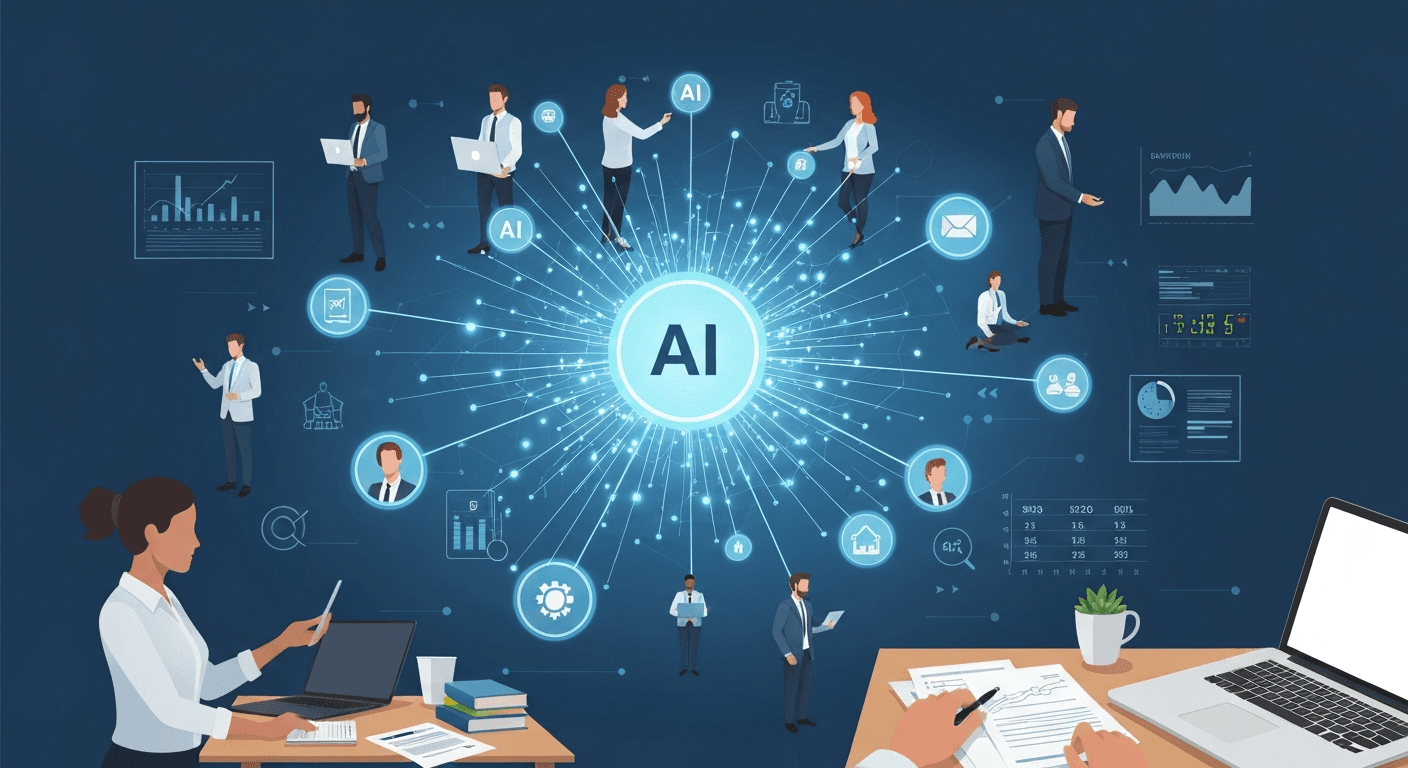
The Great AI Shift: From Tech Niche to Workplace Necessity
For years, discussions about Artificial Intelligence (AI) often conjured images of Silicon Valley engineers, complex algorithms, and futuristic laboratories. AI was perceived as the exclusive domain of data scientists and software developers, a technological frontier explored by a select few. However, a significant and rapid transformation is underway in the United States, indicating that AI is no longer a niche for the tech elite. Instead, it is becoming an integral part of nearly every job, fundamentally reshaping the American workplace and presenting both challenges and unprecedented opportunities for workers, job seekers, employers, and HR professionals alike.
Recent data underscores this dramatic shift. The number of "AI-touched" job titles in the US has more than tripled since 2022. Crucially, in the US and several other major global markets, the majority of jobs now explicitly labeled with AI are found outside the traditional technology sector. This widespread integration reflects a fundamental change: employers are increasingly making AI proficiency a core component of existing roles, demanding workers who can leverage AI tools to augment their daily tasks rather than solely those who can engineer the AI itself.
This isn't merely a theoretical trend; it's manifesting in surprisingly familiar occupations. We're seeing advertisements for "AI-enabled physical therapists," "AI-enabled truck drivers," "AI-enabled HR managers," "marketers," "salespeople," and "teachers." This reflects a burgeoning demand for individuals who are proficient in utilizing AI tools to enhance their work, making AI adoption a broad workplace phenomenon that extends far beyond the confines of Silicon Valley.
What This Means for US Workers and Job Seekers
The decentralization of AI from specialized tech roles to virtually all professions carries significant implications for the US workforce. It signals a shift towards an "AI-augmented economy," where human capabilities are enhanced by intelligent tools, leading to increased productivity and potentially new forms of value creation.
1. The Imperative of AI Literacy and Upskilling
The most immediate and critical implication for US workers is the undeniable need for AI literacy. AI skills are no longer optional; more than one-third of entry-level jobs now require some level of AI competency. This includes understanding what AI is, its capabilities and limitations, and how to use and evaluate generative AI technologies responsibly.
- For Current Workers: The call to upskill is urgent. While fears of AI replacing jobs are prevalent—with 30% of US workers fearing job replacement by AI by 2029—the reality is often more nuanced. AI is more likely to modify tasks, with 60% of US jobs expected to see significant task-level changes due to AI integration by 2030. Those in industries most exposed to AI are experiencing nearly four times higher productivity growth than others, underscoring the benefits of adoption. Investing in AI training can mean the difference between staying competitive and falling behind. The U.S. Department of Labor has even introduced an AI Literacy Framework to guide skill development across industries.
- For Job Seekers and Candidates: Demonstrating AI proficiency will become a key differentiator. Employers are not just looking for AI engineers; they want professionals who can effectively use AI tools, evaluate AI-generated outputs, and apply AI to improve business results. Skills such as prompt engineering (knowing how to effectively interact with AI models), AI-powered data analysis, workflow automation, and ethical AI judgment are among the most sought-after.
Practical Recommendations for US Workers and Job Seekers:
- Assess Your AI Readiness: Identify how AI tools are impacting your current role or desired career path. Are there AI applications specific to your industry (e.g., AI in marketing, healthcare, logistics)?
- Embrace Foundational AI Literacy: Dedicate time to understanding the basics of AI, especially generative AI. Many resources, including the U.S. Department of Labor's free AI 101 course, can help build foundational AI skills.
- Master Prompt Engineering: For roles involving content creation, analysis, or communication, learning how to write effective prompts for large language models (LLMs) is invaluable. This skill allows you to generate consistent, safe, and business-ready outputs.
- Develop AI-Assisted Data Analysis Skills: With organizations collecting more data than ever, the ability to use AI tools to turn information into insights is highly prized.
- Focus on Workflow Automation: Identify repetitive tasks in your work and learn how AI tools can automate them, freeing you to focus on higher-value activities.
- Cultivate Ethical AI Judgment: Understand data privacy, bias, transparency, and governance considerations related to AI. Knowing when human oversight is necessary is a critical and valuable skill.
- Seek Out Training and Certification: Look for online courses, workshops, or certifications offered by educational institutions, industry bodies, or even your employer. Many modern AI skills, including prompt engineering and workflow automation, require little to no coding experience and can be learned relatively quickly.
- Highlight AI Proficiency on Your Resume/Profile: Actively include specific AI tools you've used and the positive impact they had on your work in your professional materials.
Implications for US Employers and HR Professionals
For US businesses and the HR functions within them, this broad diffusion of AI presents a strategic imperative. The shift isn't just about adopting new technology; it's about fundamentally rethinking talent strategy, learning and development, and the employee experience.
1. Reshaping Talent Acquisition and Retention
The demand for AI skills is rapidly outstripping supply, leading to a significant AI skills gap. Companies are facing pressure as AI-exposed industries report significantly higher productivity growth, making AI talent crucial for competitive advantage.
- For Employers: Talent acquisition strategies must evolve to identify candidates with AI literacy and practical application skills, even for non-tech roles. This might involve revamping job descriptions, incorporating AI proficiency assessments, and actively seeking candidates who can "use" AI rather than just "build" it. Given the scarcity of AI-ready talent, employers are increasingly willing to pay a premium for these skills, with workers possessing AI skills commanding a wage premium of roughly 56% over peers without them.
- For HR Professionals: HR is at the forefront of this transformation. 92% of HR leaders report participation in AI implementation, with many involved in active decision-making. HR's role extends to identifying skill gaps, creating learning opportunities, and helping employees understand where AI can add value. However, a significant challenge is that over a third of HR leaders report having limited or no theoretical understanding of AI, creating a gap between their involvement and their foundational knowledge.
2. Strategic Learning and Development (L&D)
The focus must shift from isolated training programs to embedding AI learning into the organizational culture. Employers need to equip their employees with AI skills to increase productivity, efficiency, and innovation.
- For Employers: Implementing AI effectively requires a structured approach to employee training. This includes assessing current AI literacy across the workforce, creating a tailored AI training roadmap (from basic literacy to hands-on application), and providing ongoing, practical, on-the-job training. Cultivating an AI learning culture through continuous updates, hackathons, and internal communities is essential for long-term success.
- For HR Professionals: HR must move beyond being mere users of AI tools for tasks like drafting communications or job descriptions. They need to be strategic partners in designing and implementing organization-wide AI training programs. This involves defining "AI fluency," identifying role-specific AI applications, and developing programs that reduce employee resistance by framing AI as a productivity partner. HR is uniquely positioned to manage cultural shifts and employee anxieties around AI.
3. Ethical AI Deployment and Workforce Planning
As AI becomes more integrated, ethical considerations, data privacy, and the responsible use of these powerful tools become paramount.
- For Employers: Companies must develop clear guidelines and policies for AI usage, ensuring transparency and addressing potential biases. While AI can boost productivity and company growth, the impact on specific job roles and potential displacement needs careful workforce planning. It's important to note that while some tasks may be automated, leading to changes in roles, firms that adopt AI extensively tend to be larger, more productive, and show higher employment growth.
- For HR Professionals: HR's involvement in AI strategy development from the outset is crucial for ensuring equitable AI adoption. They can provide valuable insights into which tasks are suitable for automation, how AI strategies will impact roles, and the reskilling needs of the workforce. HR leaders are vital in bias testing, ethical training, and oversight of AI tools used in hiring and performance evaluation. They also play a key role in ensuring data privacy and compliance with evolving regulations. Without HR's early involvement, there's a risk of implementing AI solutions that may not align with employee capabilities or career aspirations, leading to pushback.
Practical Recommendations for US Employers and HR Professionals:
- Conduct an AI Readiness Audit: Assess your organization's current AI adoption levels, identify key business areas that can benefit from AI, and evaluate your workforce's existing AI skills and gaps.
- Develop a Comprehensive AI Learning Strategy: Create a tiered training program, starting with basic AI literacy for all employees, and progressing to role-specific AI application training for different departments (e.g., marketing, finance, HR, operations). Frame AI as a tool for augmentation, not replacement.
- Revamp Job Descriptions and Recruitment: Integrate AI literacy and practical AI tool usage into job descriptions for relevant roles. Develop assessment methods to evaluate candidates' AI proficiency during the hiring process.
- Invest in Internal AI Champions and Mentors: Establish programs where early adopters or AI-proficient employees can coach colleagues, fostering a peer-to-peer learning environment.
- Integrate HR into AI Governance: Ensure HR leaders are actively involved in AI strategy development from the design phase, not just implementation. Their insights are invaluable for ethical considerations, workforce impact, and employee acceptance.
- Prioritize Ethical AI Guidelines: Develop clear internal policies and training on responsible and ethical AI use, addressing issues like data privacy, bias, and human oversight.
- Foster a Culture of Experimentation and Continuous Learning: Encourage employees to experiment with AI tools in their daily tasks, celebrate successes, and learn from challenges. Provide resources and time for ongoing skill development.
The Augmented Future of Work: A Collaborative Path Forward
The spread of AI across the US labor market signifies a profound evolution, not an "AI jobs apocalypse." While AI can automate tasks and lead to significant modifications in roles, the evidence suggests that AI primarily augments human work, leading to increased productivity and growth in firms that adopt it. Rather than widespread job losses, the challenge lies in adapting to new ways of working and acquiring the skills to thrive alongside AI.
The future of work in the US will be characterized by a symbiotic relationship between humans and AI. For individuals, this means embracing a mindset of continuous learning and proactively developing AI competencies. For employers and HR professionals, it demands strategic leadership in talent development, ethical governance, and cultural transformation. By fostering AI literacy and integrating AI thoughtfully, the US workplace can harness the full potential of this revolutionary technology, driving innovation, enhancing productivity, and creating a more dynamic and capable workforce for the years to come.